 VividPlay Arcade
VividPlay Arcade
VividPlay Arcade
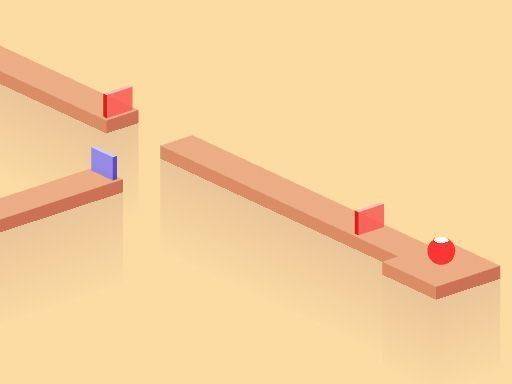
Hue Trail Logic Challenge keeps its rules minimal: tap to cycle the sphere's color and match each barrier. That simplicity supports a smooth difficulty ramp from two colors to faster movement and alternating sequences. The bright, uncluttered visuals and short level times suit children, seniors, and anyone wanting a low-pressure mental workout. Its main limitation is that the core loop stays the same throughout, so players seeking mechanical variety may find it repetitive.
Each level in Hue Trail Logic Challenge presents a winding trail lined with barriers. A sphere rolls forward, and every barrier only lets it pass when the sphere's current color matches. You tap the screen to cycle through the available hues, timing each change so the sphere reaches the next barrier in the right color. A correct match lets it roll on; a mismatch stops it and forces a quick correction. That single rule creates a repeating cycle of scanning ahead, planning taps, and adjusting on the fly.
Success depends less on fast tapping than on looking ahead. You need to scan the upcoming path to see which colors will appear and map out your taps in advance. In later levels, barriers arrive in quicker succession, so you commit to a sequence of changes rather than reacting one at a time. Spotting repeating color patterns gives you an edge, turning each stage into a small logic puzzle rather than a pure reflex test.
Levels are arranged in a linear sequence that builds on skills from earlier stages. The first puzzles teach the matching mechanic with only two colors and generous time windows. As you advance, the sphere moves faster, more shades appear, and some levels introduce alternating color sequences that require you to predict the next change. The ramp is gradual, so the challenge grows without becoming overwhelming. Hints are available and do not penalize progress, which makes them useful learning tools.
Bright, saturated colors and clean geometric shapes keep attention on the path and barriers. Backgrounds stay simple, smooth animations make the sphere's motion feel fluid, and subtle particle effects mark successful passages without distraction. The palette shifts between levels to reduce visual fatigue. Controls are limited to a single tap, so the game works on any touchscreen or mouse. There is no text-heavy tutorial; the opening levels introduce the mechanic naturally. Each puzzle takes roughly thirty seconds to two minutes, progress saves automatically, and there are no timers or score multipliers pushing you to rush.
Sign in to comment
You must be logged in before posting a review or rating.
No comments yet. Be the first to comment!




Editorial Notes