 VividPlay Arcade
VividPlay Arcade
VividPlay Arcade
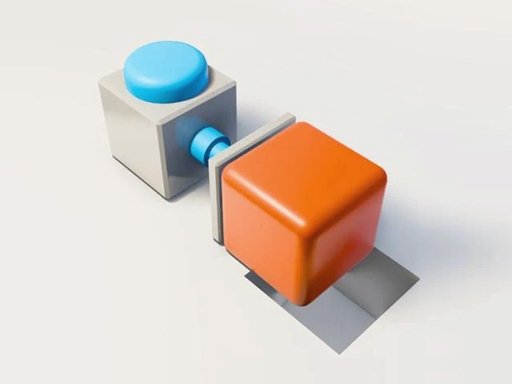
Block Puzzle 3D stands out by making you operate machines instead of moving blocks directly. That indirect control, combined with possible move limits, shifts the focus from quick tapping to sequencing and foresight. The gradual introduction of new machine types keeps later puzzles from feeling repetitive. It suits players who enjoy spatial reasoning and a relaxed pace, though those seeking action or story will find it minimal. The hint system offers a safety net without removing the challenge.
In Block Puzzle 3D, the objective is straightforward: each block must end up in its designated crater. You do not move blocks directly. Instead, you operate on-screen machines that push blocks across the level. This indirect control means every action affects the block's path, and a single push can send it off course if the layout is not studied first. The game presents this task in a three-dimensional environment, so depth and alignment matter as much as direction.
Multiple machine types appear across the puzzles, each changing how a block travels. Some may push in a straight line, while others might alter direction or apply force differently. The game introduces these machines gradually, so early levels function as tutorials. As new machines appear, the solution space widens, and later puzzles require you to chain actions across several machines. Each level has a unique layout, which prevents the puzzles from feeling like repeats of the same idea.
Levels often limit the number of moves you can make. That constraint turns each puzzle into a sequencing problem: you must decide not only which machine to use but also in what order. Wasting a move can leave a block stranded or make the crater unreachable. The game encourages you to study the layout before acting and to plan a full sequence rather than improvising. Patience and observation are more useful than quick reactions.
The difficulty rises steadily. Early puzzles teach the basic push mechanic with few distractions. Later ones combine multiple machines and tighter move limits, demanding more careful foresight. A hint system is available for players who get stuck, though using it sparingly keeps the challenge meaningful. The controls are simple to learn, and the family-friendly design makes the game approachable for a wide range of ages.
Sign in to comment
You must be logged in before posting a review or rating.
No comments yet. Be the first to comment!







Editorial Notes